When Countertop Gadgets Slow Dinner Down
Countertop gadgets can slow dinner when setup and cleanup interrupt the work. Learn how to judge a tool by the full cooking sequence it creates.
Countertop gadgets can slow dinner when setup, transfers, and cleanup interrupt the cooking sequence. A food processor may chop vegetables quickly, yet its bowl, blade, and rinse-up can add work that a knife and cutting board would avoid.
To judge whether a tool helps, follow one job from its first reach to its last cleanup. The useful question is not how many things an appliance can do, but whether it makes a particular cooking task easier without adding a more awkward one.
How do you compare a gadget with a hand tool?
Count the whole sequence. For a blender, the main action might be puréeing soup; the surrounding actions include setting out the base, moving hot food into the jar, cleaning the blade area, and returning the appliance to storage. A tool can shorten the central action and lengthen everything around it.
That trade-off becomes visible at handoffs. If you need to stop chopping to assemble a processor, clear room for its bowl, then wash it before using the sink for anything else, the gadget may interrupt the meal rather than support it. A knife already in hand could be the simpler choice for a small amount.
- Setup: If the appliance needs a base, attachment, cord, or special container, then decide whether that setup fits naturally before the task; otherwise, use a hand tool already on the counter.
- Transfer: If food must move through several bowls before reaching the pan, then choose a tool that reduces transfers; otherwise, keep the current route.
- Cleanup: If working parts can be rinsed promptly without blocking another task, then keep the appliance in consideration; otherwise, favor the tool with the simpler cleanup.
- Storage: If the appliance has a stable, accessible home, then it may be easy to retrieve; otherwise, decide whether a nearby cupboard or a different tool is more practical.
These checks are not reasons to avoid appliances. They help show whether a tool simplifies a repeated action or creates a troublesome chain around it.
When does countertop clutter slow a cooking task?
Countertop gadgets can slow dinner when they occupy the places where food and cookware need to land. A cutting board needs a flat surface; a mixing bowl needs somewhere to sit; a hot pan needs a safe resting place. If those spots are covered, the cook starts shifting objects to make room.
Those extra moves can muddle the sequence. A small dish of chopped ingredients may disappear behind a mixer, while a damp towel gets pushed toward the edge. The issue is not that every counter must be bare. It is whether the tools left out obstruct the next action.
- Work surface: If a board cannot sit flat, move an appliance for the session; otherwise, leave the board’s area ready for preparation.
- Food landing spot: If there is no place for a bowl or finished ingredients, clear a section or use a suitable nearby surface; otherwise, keep the current arrangement.
- Hot cookware: If a pan has no safe place to rest, shift nonessential gear before cooking; otherwise, keep the intended landing area clear.
- Visibility: If a machine hides small dishes or tools needed next, relocate it; otherwise, avoid rearranging the counter without a reason.
- Next task: If the appliance blocks the path from preparation to cooking, move it for that meal; otherwise, leave it where it is.
- Power and water: If using the appliance would put its cord or base in a wet or awkward area, follow its instructions and choose another position or tool; otherwise, use the approved setup.
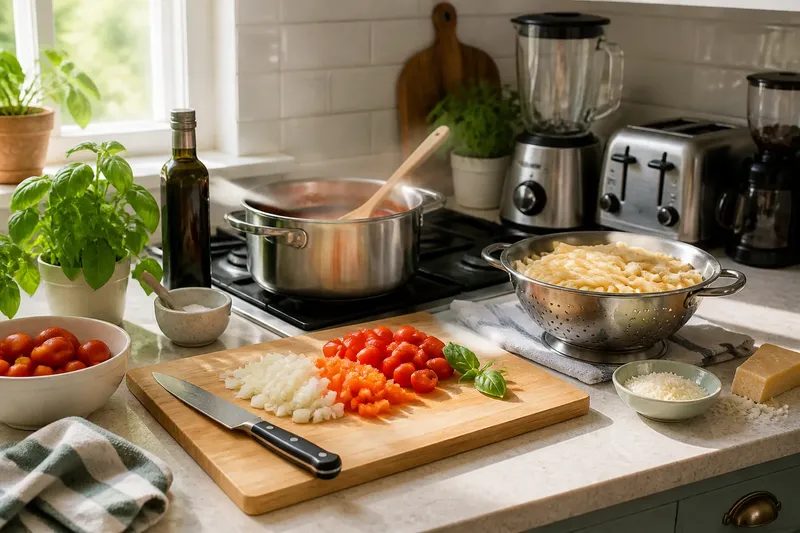
Imagine you are making tomato sauce and pasta on a counter crowded by a toaster, blender, and coffee grinder. You move the blender to a nearby shelf, set a cutting board and bowl beside the stove, and leave a clear place for the drained pasta. The observable result should be fewer objects to shift during chopping and a ready landing spot for the pasta; the recipe itself stays the same.
Which cooking jobs suit a countertop appliance?
An appliance makes sense when it handles a repeated, physically demanding, or awkward task. A stand mixer can keep dough moving while you prepare another part of a meal. An electric kettle heats water without taking a burner. A food processor can help with a large batch of finely chopped vegetables.
Frequency matters, but it is not the only consideration. A machine for an occasional task may occupy a surface needed every day. An appliance used often may earn a nearby spot if getting it out is the main friction. Someone with limited hand strength may also value an electric chopper for a small amount of food, even when a knife would take less setup.
- Choose a dedicated appliance if its job recurs and it can operate without crowding the next task; otherwise, consider storing it or using another tool.
- Choose a hand tool if the job is small and the tool is already ready to use; otherwise, consider whether an appliance would reduce strain or simplify repetition.
- Borrow or share a specialty tool if you need it rarely and can arrange sensible storage and cleaning; otherwise, decide whether a simpler method will do.
The right comparison is between the actual task and the actual kitchen, not between a gadget and an imagined ideal setup.
How can you tell whether a tool saves time?
Notice repeated interruptions instead of judging by how quickly a blade spins. During a familiar meal, pay attention to pauses for fetching, assembly, moving, pouring, rinsing, or putting away. If a tool removes a recurring pause without creating a worse one, it may suit that routine. If it adds setup at the busiest moment, its narrow benefit may not be worth the disruption.
Keep the observation informal. After cooking, ask which action felt clumsy and what caused it. The answer might be an appliance, but it could also be a misplaced peeler, a missing bowl, or a cord in the way.
For a clearer comparison, prepare the same kind of meal on separate occasions, once with your usual method and once with the alternate tool. Keep the menu and work area reasonably similar. Notice where your hands pause and what needs cleaning; treat the result as a clue about your routine, not a verdict on the appliance.
What should you check before leaving gear out?
Before giving an appliance a permanent place, check how it fits the way you cook. Each observation should point to a practical choice:
- Reach: If you can use it without an awkward lift or reaching over a hot burner, then its position may work; otherwise, store it lower or choose another location.
- Landing room: If its bowl, lid, and finished food have a place to sit, then the spot may be workable; otherwise, clear a nearby surface or store the appliance.
- Outlet: If the cord reaches without crossing a wet area or obstructing work, then the outlet may suit the setup; otherwise, follow the appliance instructions and select another approved position.
- Cleanup path: If removable parts can reach the sink without disrupting another task, then cleanup may fit the routine; otherwise, consider a simpler tool or a different storage spot.
- Surface trade-off: If the appliance’s footprint does not displace a more useful daily work area, then leaving it out may be reasonable; otherwise, keep it nearby but off the active counter.
If the answers are mixed, try a temporary home in a nearby cupboard or on a shelf. Keep attachments together in a bin if that makes retrieval easier. Follow the manufacturer’s instructions for safe placement and use.
Which questions help you choose countertop gadgets?
Does a food processor replace chopping by hand?
It can handle a batch of evenly sized pieces, but it needs a bowl, blade, setup, and cleanup. For a small amount, compare that full sequence with using a knife and cutting board.
Is an appliance useful if it stays in a cupboard?
It may be, especially for a task that feels awkward with hand tools. If retrieving it makes you avoid the task, a more accessible storage spot may help more than leaving it on the counter.
Can countertop gear help in a small kitchen?
It can if it replaces a slow or tiring action and has a clear place to work. It can also crowd the board, sink, or hot-pan landing area, so consider the space it occupies during use.
Should a frequently used appliance always stay out?
Not necessarily; frequency is only one part of the choice. Keep it out if ready access helps without disrupting the surface, and store it nearby if the counter serves another daily task better.
What can one cooking session reveal?
Before replacing or buying anything, remove one seldom-used item from the active counter and cook a familiar meal. Notice whether the clearer surface makes a handoff easier, such as moving chopped ingredients into a bowl or setting down a hot pan. That observation can show whether the problem is missing equipment or gear in the way.
Countertop gadgets speed dinner only when they fit the full cooking sequence. For countertop gadgets and faster dinner, judge the tool by its setup, transfers, cleanup, and effect on the next task. A clear patch of counter is not wasted space; it is where the next useful action can happen.