Why a Chef’s Knife Has a Curved Edge for Rocking Cuts
Why a chef’s knife has a curved edge: see how the tip stays near the board to guide a controlled rocking cut through herbs and vegetables.
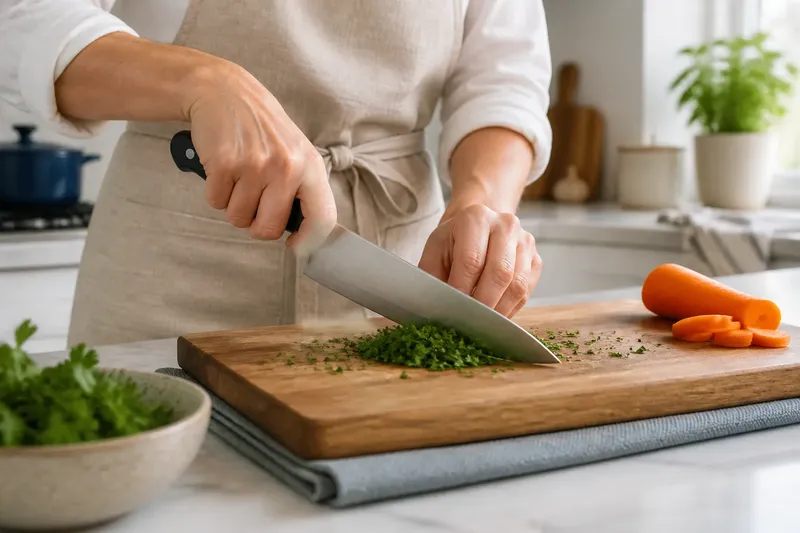
Why a chef’s knife has a curved edge becomes clear when you mince a small pile of parsley: the blade can pivot through the herbs while its tip stays near the board. That rocking cut is not a dramatic seesaw. It is a compact motion, and the curve helps the edge meet the food in sequence.
Imagine Lena preparing parsley and a peeled carrot for soup. She starts with a chef’s knife, a stable cutting board, and a damp towel folded beneath the board to keep it from shifting. Her aim is not speed. She wants to understand why the blade’s profile changes the way it moves, and what to do when the cut feels more like chopping than rocking.
What does the curve change?
Look at a chef’s knife from the side. Its cutting edge usually rises gradually from the heel toward the point. The exact curve varies by knife, but it gives the blade a rounded path of contact rather than a uniformly flat edge.
On a rocking cut, the tip acts as a pivot near the board. Lena lowers the handle, then raises it again, letting more of the curved edge travel through the food. The knife does not need to leave the board completely between cuts. Its contact shifts along the edge as the handle moves.
That differs from a straight up-and-down chop, where the blade lifts and lands more vertically. Neither motion is automatically better: a chop suits some firm ingredients and tasks, while rocking can be comfortable for repeated, compact cuts. The blade’s curve makes the rocking option available; it does not require every cut to use it.
How does Lena keep the tip near the board?
Lena places the parsley leaves in a loose pile, then holds the knife with a relaxed grip and keeps her other hand’s fingertips curled back. She sets the tip close to the board before moving the handle. The point stays in roughly the same area while the blade’s heel rises and falls.
Her first few motions are too large. The tip lifts well clear of the board, so the knife lands with a thud and the herbs scatter. She shortens the arc, keeping the point low and allowing the handle to do most of the visible movement. The edge now passes through the parsley instead of striking down on it.
The non-knife hand guides the food, not the blade. Lena gathers the leaves into a compact mound with curled fingertips, then advances that hand gradually as she cuts. She keeps her attention on the edge and works at a pace that lets her maintain control. A sharp knife and a stable board make controlled contact easier; if the knife slips or feels damaged, stop using it until the issue is addressed.
What happens when the motion meets real ingredients?
Lena begins with the parsley. She rocks across the mound in short passes, then pauses to gather stray leaves with the flat side of the blade. A few more controlled passes bring the pieces closer in size. She does not press down harder to compensate for leaves that escape; she tightens the pile and resets her starting position.
Next comes the carrot. Lena cuts it into manageable pieces before trying to make smaller cuts, so it sits more steadily on the board. She uses a deliberate downward cut for the initial pieces rather than forcing a rocking motion onto an awkward shape. Once the pieces are stable, she can use the knife’s curve for a gentle rocking pass if the task calls for it.
This distinction matters: a curved edge supports a motion, but it cannot make an unstable ingredient safe or a poor setup comfortable. The food should be arranged so it does not roll, and the blade should meet it with control. If the ingredient’s shape makes the tip hard to keep near the board, choose a simpler cut or reposition the food instead of exaggerating the swing.
Why does the tip need to stay close to the board?
Keeping the tip near the board gives the blade a consistent pivot point. That steadies the rocking arc and helps Lena direct the edge through the food without turning each stroke into a high lift and hard landing. The tip need not be pinned down with force; it stays close through a modest, controlled motion.
When the tip rises too far, the knife behaves more like a chopping tool. The handle travels through a wider arc, the landing can feel less controlled, and light ingredients may shift. When the tip stays low, Lena can make a smaller adjustment at the handle and keep the blade’s movement contained.
Imagine the parsley pile spreading toward the board’s edge. Lena stops, draws the leaves back into the center with the blade’s flat, and resumes with the tip near the board. The observable result is a neater work area and fewer leaves pushed away by the blade. The lesson is simple: reset the food when the setup changes; do not try to rescue the cut with a bigger swing.
Which questions help you choose the motion?
Can every chef’s knife rock?
Many chef’s knives have enough curve for a rocking cut, though the shape and balance differ from one blade to another. Try a small, slow motion with the tip close to the board and see whether the edge travels comfortably through the ingredient.
Should the knife tip stay planted?
It should remain close to the board as a pivot, but pressing it down hard is unnecessary. Let the handle guide the arc, and keep the movement small enough to control.
Is rocking the best way to mince herbs?
It can work well for a compact pile when the leaves are gathered and the blade moves in short passes. If the herbs scatter or bunch beneath the edge, pause to regroup them rather than speeding up.
What if rocking feels awkward?
Use a controlled downward cut or another comfortable motion suited to the ingredient and task. A chef’s knife’s curve offers an option, not a rule; a stable setup and deliberate handling matter more than copying a particular rhythm.
What does Lena learn from the finished cut?
By the time Lena adds the parsley to the soup, she can tell the difference between a useful rock and an oversized swing. Her knife’s curved edge lets the blade roll through the herbs while the tip stays close to the board, but the result depends on her keeping the pile together, choosing a suitable motion for the carrot, and controlling the handle.
For anyone wondering why a chef’s knife has a curved edge, the answer is practical: the curve supports a smooth rocking path. Start with a small pile of food, a steady board, and a short arc. If the tip keeps lifting, reduce the motion until the blade can pivot near the board without force.